
After 25+ years in healthcare technology, I’ve learned something fundamental: the practices that scale successfully aren’t necessarily the ones with the biggest vision or the most innovative treatments. They’re the ones that built the right operational infrastructure early.
The premium practice market has exploded from 8,899 to 10,488 med spa locations between 2022 and 2023, yet 48% of these practices experience medical director turnover annually due to operational burden and compliance complexity (American Med Spa Association 2024). Sadly, most clinics are running on systems that weren’t designed for the unique challenges of cash-pay, luxury medical services.
Your med spa or wellness clinic might offer cutting-edge peptide therapy and hormone optimization, but operational reality reveals a stark truth: administrative inefficiencies cost the U.S. healthcare system $265 billion annually, with 28% of administrative spending completely eliminable without compromising quality or outcomes (McKinsey & Company 2021). These aren’t small operational hiccups – they’re compounding inefficiencies that limit your capacity, stress your team, and create friction in the patient experience you’ve worked so hard to build.
Your space probably looks incredible. You’ve attracted patients who value premium care. But here’s the operational reality I’ve seen play out dozens of times: clinical excellence without operational infrastructure eventually hits a ceiling.
That ceiling isn’t your fault. It’s just math. And it’s fixable.
The Infrastructure Gap Nobody Talks About
I’ve worked with companies serving 1.4 million people. I’ve been on both the provider and payer sides of healthcare. And here’s what I’ve observed: most premium practices build forward-thinking clinical protocols on top of backward-looking operational systems.
Legacy e-prescribing feels like sending a fax from a horse-drawn carriage because it essentially is. Despite 92% adoption rates, government data confirms that 11.7% of all e-prescriptions contain errors, with 60.7% involving critical omitted information requiring manual correction by pharmacy staff (AHRQ 2023). Every prescription that requires a phone call, every clarification that needs a fax – these are symptoms of infrastructure built for yesterday’s healthcare, not tomorrow’s.
Think about your prescription workflow right now. Research documents that pharmacists must call physician offices multiple times daily for prescription clarification, with communication via telephone and fax creating constant workflow disruptions (Schiff et al. 2015). The lack of interoperability between pharmacy dispensing systems and physician EHRs means your staff is manually entering the same data multiple times – a hidden tax on every prescription you write.
These aren’t small operational hiccups. They’re compounding inefficiencies that limit your capacity, stress your team, and create friction in the patient experience you’ve worked so hard to build.
Pay Me Now or Pay Me Later: The Operational Reality
Nothing in operations is free – you either invest in the right infrastructure now, or you pay significantly more later. McKinsey’s operational transformation data shows interventions require one-time spending of 0.7 to 1.0 times annual savings but deliver 5-10% sustainable cost improvements, with organizations pursuing proper productivity programs twice as likely to achieve top-quintile performance (McKinsey & Company 2023). This is the “pay me now or pay me later” philosophy in action.
The value of solving operational problems today is not the same as solving them tomorrow. Every day you operate with inefficient systems, you’re paying an opportunity cost – in staff time, in patient experience, in growth you could be capturing but aren’t.
The numbers tell a sobering story: 90% of medical groups report cost increases in 2025, with labor costs now consuming between 50% and 84% of total operating expenses due to manual processes and workflow inefficiencies (MGMA 2025). When your team spends hours managing pharmacy coordination, prior authorizations, and prescription tracking, that’s not just time lost – it’s revenue left on the table and growth opportunities missed.
This is what I call the “crawl, walk, run” philosophy. You don’t need perfection immediately. You need the right foundational pieces in place now so you can scale smoothly later.
Technology-Enabled Service (Not Just Technology)
Here’s a critical distinction from MIT’s research: the most effective solutions aren’t just technology platforms – they’re technology-enabled services. Digital health platforms employ platform-based business models connecting multiple stakeholders through unified interfaces, while simple technology additions just layer digital features onto existing broken workflows (MIT Sloan Management Review 2024). The difference determines whether technology multiplies your efficiency or just digitizes your inefficiencies.
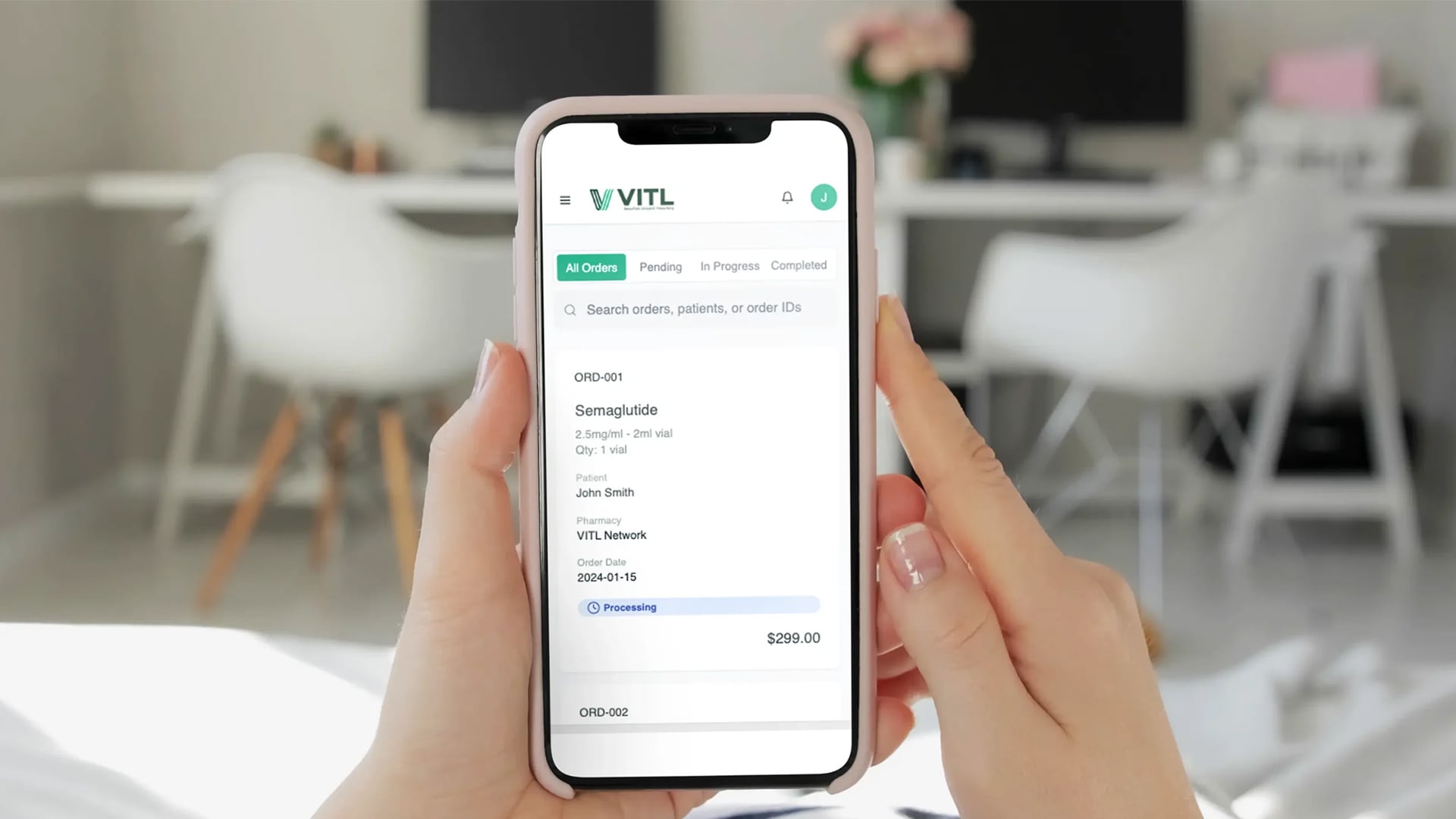
At VITL, we think about e-prescribing as a service that happens to be delivered through a platform. The platform is an enabler – a multiplier of your existing process. It’s not the centerpiece you have to build everything else around.
This is why operations at VITL stay very close to our actual users. We’re not insulated behind layers of administration. We communicate directly with your clinic staff and clinicians who use the platform daily. That tight feedback loop lets us iterate quickly and build features that create real operational value, not theoretical value.
Frictionless by Design: What That Actually Means
I think about operational infrastructure as needing to be frictionless. You almost don’t want people to see that the technology is there. It should just work – achieving the job and creating value without adding complexity.
When I evaluate operational processes, I ask: Is this simplifying something or complicating it?
Traditional healthcare technology often adds layers of complexity on top of already complex systems. You get a new tool, but now you need training, workarounds, and manual processes to make that tool fit your workflow. Our CEO Charlie often says this, and I must repeat it here: we’re not using technology to create tools, we’re using technology to eliminate work.
The right approach is beautifully simple: understand the service that needs to be delivered, the value that needs to be created, and then build technology that enables that process to happen more efficiently.
For prescription management, the core service is simple: get the right medication to the right patient at the right time. Everything else should support that – not complicate it.
Building Infrastructure for Scale (While You’re Still Small)
One advantage of my experience with larger healthcare companies is recognizing operational pitfalls before you hit them. When you’re managing technology for 1.4 million people, you learn which infrastructure decisions matter early.
At VITL, even though we’re an early-stage company serving hundreds of clinics (not millions of patients), we’re thinking about your business three to five years out. What will it look like to serve needs you don’t have yet – when you’re at a higher scale? What do we need to build today to prepare for that future together?
Building for tomorrow while you’re still small isn’t premature – it’s strategic. Federal health IT frameworks emphasize five critical building blocks for scalable infrastructure: technical standards, certification processes, security protections, trusted data exchange, and governance frameworks (Office of the National Coordinator 2015). The foundational pieces you implement today determine whether you’ll scale smoothly or hit operational ceilings that require expensive retrofitting.
Sometimes this feels like it’s slowing things down in the short term. A team that’s been running hard and fast might wonder why we’re focusing so much on certain processes or frameworks that don’t seem immediately necessary.
But this is classic pay-me-now-or-pay-me-later thinking. Ensuring we have the right operational foundation now – the right security frameworks, the right compliance structures, the right process documentation – makes scaling exponentially easier later, for everyone.
The foundational pieces we have put in place this year are the reason we will be able to scale quickly and confidently next year – this is true on every level.
The Simplicity of the Problem (And Why Others Haven’t Solved It)
One thing that struck me about VITL’s mission is how relatively simple the core transaction is compared to most healthcare technology challenges.
You have one clinic needing to get one prescription to one pharmacy. That’s fundamentally less complex than systems involving clinicians, insurers, patients, hospital administrators, and multiple decision points.
Yet when it comes to specialty medications and compounding, 503A pharmacies operate under specific FDA exemptions but face significant operational barriers including interstate distribution limits (5% threshold), individual prescription requirements, and risk-based inspection protocols that aren’t available on-demand (FDA 2023). This regulatory complexity creates access issues that cascade into your practice’s daily operations, turning what should be simple prescription fulfillment into multi-step manual processes.
This simplicity creates real advantages:
- Faster new feature creation
- Better feedback loops with users
- Easier to test and validate what works
So why hasn’t someone else solved this already?
Healthcare technology companies often get stuck in traditional healthcare thinking that overcomplicates problem-solving. We’ve taken a more practical approach: solve the actual problem in the simplest way that creates value.
Rather than spending a year planning and designing, we’re focused on delivering value to our clinics directly, immediately – then evolving and refining based on what we learn from their feedback.
What Operational Excellence Actually Looks Like
When operations and technology align correctly, specific things happen:
Provider efficiency increases. Not because people work harder, but because the system handles logistics automatically. Prescriptions that took multiple phone calls and portal logins now take seconds.
Staff capacity expands. Beyond financial metrics, operational inefficiency drives workforce burnout. A joint study by major pharmacy organizations documents how manual prescription processing, lack of EHR interoperability, and prior authorization burdens contribute to unsustainable workloads, with pharmacy workflow inefficiencies identified as primary drivers of professional dissatisfaction (ASHP, APhA & NABP 2023). When operations run smoothly, staff capacity expands not because people work harder, but because the system handles logistics automatically.
Patient experience improves. Real-time visibility into prescription status means fewer anxious calls, less uncertainty, and a smoother overall experience.
Growth becomes manageable. The operational infrastructure that serves 100 patients can scale to serve 1,000 without proportionally increasing complexity or headcount.
This is what happens when you build the right operational foundation.
The Provider-Payer Perspective Applied to Operations
Having worked on both provider technology and payer systems, I understand the complexity that exists on both sides. That experience shapes how I think about VITL’s position.
We sit in the middle – between clinics and pharmacies. Our job is to be the frictionless layer that connects them without adding any complexity to either side.
The clinic doesn’t need to understand pharmacy logistics. The pharmacy doesn’t need to rebuild their systems. VITL is the infrastructure that makes this connection seamless. We can optimize for both sides simultaneously because we understand what each needs.
Building for Tomorrow, Starting Today
If you’re running a premium practice, you’ve already invested heavily in clinical excellence, physical space, and patient experience. Those investments were spot on.
But operational infrastructure deserves the same level of attention and investment. Not because what you have is broken, but because building the right infrastructure now determines how effectively you can scale later. And with VITL, the investment is a no-brainer – the platform is free to use.
The practices that will dominate the next generation of premium wellness care won’t necessarily be the ones with the biggest marketing budgets. They’ll be the ones that built operational excellence into their foundation early.
The Practical Path Forward
At VITL, we’ve built a beautifully simple e-prescribing service specifically for premium practices that want the competitive advantage of operational excellence.
Real-time prescription tracking. Instant pharmacy access. Automated workflows. These aren’t luxury features anymore, they’re basic necessities for practices that want to scale without sacrificing quality.
The question isn’t whether to upgrade your operational infrastructure. It’s when – and whether you’ll do it proactively or reactively.
From an operations standpoint, I can tell you: proactive always costs less.
Ready to build operational excellence into your practice foundation? See how VITL creates the infrastructure that lets premium practices scale smoothly.
VITL delivers technology-enabled prescription services that multiply your operational capacity without multiplying your complexity. Because your clinical excellence deserves operational infrastructure that matches.
References
- AHRQ (2023) ‘E-prescribing: E for error?’, Patient Safety Network, Agency for Healthcare Research and Quality. Available at: https://psnet.ahrq.gov/web-mm/e-prescribing-e-error
- American Med Spa Association (2024) ‘2024 Medical Spa State of the Industry Executive Report’, AmSpa. Available at: https://americanmedspa.org/blog/2024-medical-spa-state-of-the-industry-executive-report-recap
- ASHP, APhA & NABP (2023) ‘Implementing Solutions for Pharmacy Workforce Challenges’, American Society of Health-System Pharmacists. Available at: https://wellbeing.ashp.org/-/media/wellbeing/docs/Implementing-Solutions-Report-2023.pdf
- FDA (2023) ‘Compounding Inspections and Oversight: Frequently Asked Questions’, U.S. Food and Drug Administration. Available at: https://www.fda.gov/drugs/human-drug-compounding/compounding-inspections-and-oversight-frequently-asked-questions
- McKinsey & Company (2021) ‘Administrative simplification: How to save a quarter-trillion dollars in US healthcare’, McKinsey Global Institute. Available at: https://www.mckinsey.com/industries/healthcare/our-insights/administrative-simplification-how-to-save-a-quarter-trillion-dollars-in-us-healthcare
- McKinsey & Company (2023) ‘Clinical operations excellence: Unlocking a hospital’s true potential’, McKinsey Healthcare Systems & Services. Available at: https://www.mckinsey.com/industries/healthcare/our-insights/clinical-operations-excellence–unlocking-a-hospitals-true-potential
- MGMA (2025) ‘Medical practice operating costs are still rising in 2025 – here’s how to control them’, Medical Group Management Association. Available at: https://www.mgma.com/mgma-stat/medical-practice-operating-costs-are-still-rising-in-2025-heres-how-to-control-them
- MIT Sloan Management Review (2024) ‘Health Care Platforms Need a Strategy Overhaul’, Massachusetts Institute of Technology. Available at: https://sloanreview.mit.edu/article/health-care-platforms-need-a-strategy-overhaul/
- Office of the National Coordinator (2015) ‘Connecting Health and Care for the Nation: A 10-Year Vision’, HealthIT.gov. Available at: https://www.healthit.gov/sites/default/files/ONC10yearInteroperabilityConceptPaper.pdf
- Schiff, G.D. et al. (2015) ‘Enhancing Practice Efficiency and Patient Care by Sharing Electronic Health Records’, Perspectives in Health Information Management, 12(Fall): 1f. Available at: https://pmc.ncbi.nlm.nih.gov/articles/PMC4632871/
