
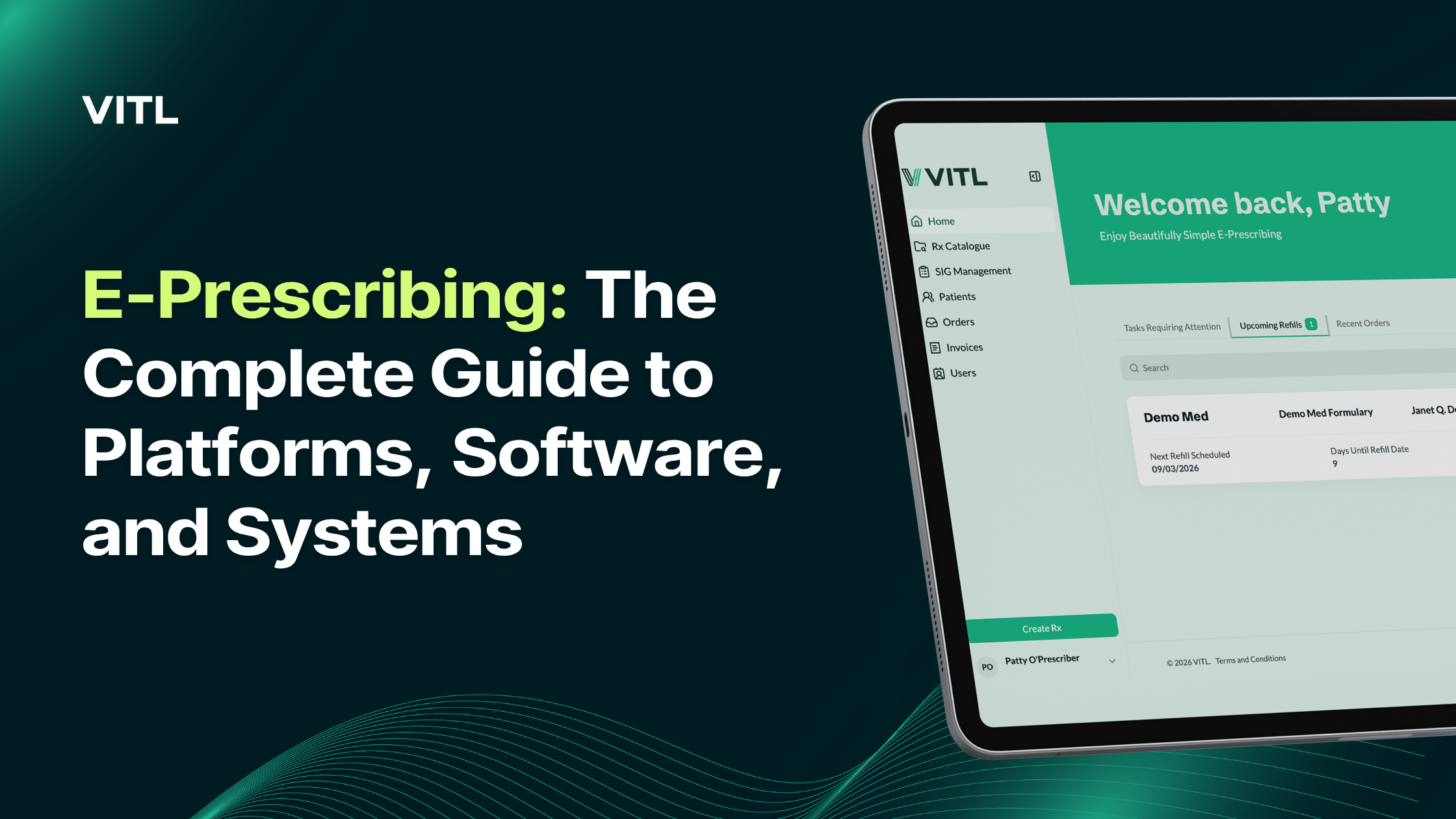
E-prescribing (eRx) is the electronic transmission of prescription information from a prescriber’s software directly to a pharmacy. In 2026 it is the dominant prescribing method, used by roughly 1.39 million U.S. prescribers according to Surescripts, and accepted by virtually all pharmacies. It now spans controlled substances, specialty medications, and compounded therapies through a growing category of e-prescribing platforms.
Key Takeaways
- E-prescribing replaces paper and fax with a standards-based electronic transmission from prescriber software to pharmacy.
- Adoption is near-universal: ~92% of prescribers e-prescribe and virtually all U.S. pharmacies accept eRx.
- EPCS (Electronic Prescribing of Controlled Substances) is mandated in most states and required for Medicare Part D Schedule II–V prescriptions above a 70% threshold.
- Modern e-prescribing platforms go beyond basic transmission, adding price transparency, order tracking, multi-pharmacy access, and multi-location controls.
- Specialty and compounding-focused e-prescribing is an emerging category serving cash-pay, DPC, weight-loss, and integrative clinics that fall outside legacy EHR workflows.
- The next evolution, AI-assisted workflow and direct-to-patient fulfillment models, is reshaping how clinics manage the prescribing-to-fulfillment lifecycle.
What Is E-Prescribing?
E-prescribing (also written as eprescribing, e-Rx, or electronic prescribing) is the process of a clinician electronically creating and transmitting a prescription from their software directly to a pharmacy. It replaces paper scripts, phoned-in orders, and faxed prescriptions with a structured digital transmission.
The Office of the National Coordinator for Health IT (ONC) defines it plainly: “E-Prescribing involves prescribers electronically entering and transmitting prescription information to pharmacies through standards-based software, enhancing convenience, cost-effectiveness, and safety by reducing errors (like handwriting) and automating drug interaction checks.” (ONC, 2024)
The adoption curve is one of the fastest in healthcare IT history. In 2008, only 7% of prescribers were sending prescriptions electronically. By 2024, that figure hit 92%, an 85 percentage-point jump. (ONC)
You will see the term written many ways: eRx, eprescribe, e prescribing, electronic prescribing, e-Rx systems. They all refer to the same core act: sending a structured prescription record from a prescriber’s software to a pharmacy’s fill queue over a certified network. Under the hood, most transmissions run on the NCPDP SCRIPT standard, the messaging format that makes interoperability possible.
E-prescribing sits at the front of the broader prescribing-to-fulfillment workflow. What happens after transmission (pricing, patient communication, tracking, refills) is where the modern platform category is now competing.
How Does E-Prescribing Work?
An e-prescribing system transmits a structured prescription from the prescriber’s software, through a certified network, to the patient’s chosen pharmacy. The prescription enters the fill queue automatically. No rekeying. No faxes to confirm.
In 2025, 1.39 million U.S. prescribers used e-prescribing, a 4.0% increase over the prior year, according to the Surescripts 2025 Annual Impact Report. Those are Surescripts network figures rather than national totals. Virtually every U.S. pharmacy sits on the receiving side of that traffic.
The flow, step by step:
- The prescriber selects a patient in the software.
- They select a medication, dose, and directions.
- The system runs clinical checks: allergy, drug-drug interaction, duplicate therapy.
- The prescriber transmits to the patient’s pharmacy of choice.
- The pharmacy receives the structured record and queues it for fill.
- The patient is notified, by the pharmacy and increasingly by the prescribing platform.
The transmission network (Surescripts is the largest in the U.S.) acts as connective infrastructure between prescribers, pharmacies, and payers. It is the reason a prescription written in one software system reliably arrives in another.
Controlled substances add two steps: identity proofing of the prescriber and two-factor authentication at the moment of signature. This is EPCS, covered in detail below.
Sending to a compounding pharmacy adds its own wrinkles. The formulation, strength, and vehicle are often non-standard. The receiving pharmacy may not be in the same retail directories a legacy EHR searches by default. This is where specialty e-prescribing platforms enter the picture.
Benefits of E-Prescribing
E-prescribing improves safety, adherence, and workflow. Handwriting errors disappear. Interaction checks run automatically. And patients are more likely to actually pick up their first fill.
A Surescripts national study found “a consistent 10 percent increase in patient first-fill medication adherence (i.e., new prescriptions that were picked up by the patient) among physicians who adopted e-prescribing technology when compared with physicians who did not use e-prescribing.” (Surescripts, 2012)
CMS puts it directly: “Electronic prescribing for controlled substances enhances patient safety through patient identity checks, medication recommendations, and timely and accurate transmission of time sensitive prescriptions. EPCS also reduces prescriber burden by deterring and detecting prescription fraud and irregularities, improving workflow efficiencies, avoiding data errors, and reducing pharmacy calls to clarify written prescriptions.” (CMS, 2025)
The concrete benefits stack up in five categories:
- Safety. Legible orders. Automated allergy and interaction alerts. Structured data instead of “was that 5 mg or 50 mg?”
- Adherence and outcomes. Patients pick up more first fills. That 10% delta compounds across a panel.
- Operational. Fewer pharmacy callbacks. Faster turnaround. Less staff time chasing clarifications.
- Fraud and diversion reduction. EPCS makes it materially harder to alter, duplicate, or forge controlled prescriptions.
- Workflow benefits from modern platforms. Price transparency at the moment of prescribing. Amazon-style patient order tracking. Formulary depth that includes compounded and specialty products. These are administrative gains, and they are new categories of benefit that legacy competitor content rarely surfaces.
E-Prescribing Software & Systems Explained
E-prescribing software is the application layer clinicians use to compose and send prescriptions. It can be embedded in an EHR, offered as a standalone eRx system, or delivered as a specialty platform focused on a specific pharmacy network.
Nationwide, 84.4% of e-prescribers are enabled for EPCS and 98.3% of pharmacies are EPCS-enabled. (Surescripts, 2025) But enabled does not equal used. A clinic can have the capability turned on and still route most controlled-substance orders through inefficient workflows. This gap is a common blind spot in software selection.
The three delivery models:
- EHR-embedded eRx. A module inside a broader clinical suite. Standard for hospitals and larger primary care groups. Deep patient-chart integration. Often thin on specialty and compounding workflows.
- Standalone eRx software. Focused on prescription creation and transmission. Lighter footprint. Good for clinics without a full EHR.
- Specialty / vertical e-prescribing platforms. Built around a specific pharmacy network or care model (compounding, cash-pay, DPC, weight-loss, integrative). Add workflow features the retail-oriented systems do not include.
A minimum feature checklist for any eRx software: patient database, drug database, formulary lookup, interaction and allergy checks, EPCS capability, refill management, and a pharmacy directory.
The category distinction that matters most: “eprescribe software” is just a transmission feature. “E-prescribing platform” is a workflow layer above it. One connects to a pharmacy; the other unifies many pharmacies… and there’s a world of difference.
E-Prescribing Platforms vs. Legacy Software
A modern e-prescribing platform is a workflow layer, not just a transmission tool. It consolidates pharmacy relationships, adds price comparison, tracks orders, and manages multi-location operations. Legacy eRx software stops at the point of transmission.
Across the specialty and cash-pay clinics we work with, it is common to see several active compounding pharmacy relationships running at once. Each pharmacy has its own portal, its own login, its own formulary, its own pricing sheet, and its own order-status page. Staff log in to all of them, several times a day.
No one has published a count of how many pharmacy portals a specialty clinic logs into in a given week. The nearest measured analogue sits on the payer side: a March 2026 MGMA Stat poll of 252 practices found 61% have staff accessing seven to 10 payer portals a week (35%) or 11 or more (26%). Compounded ordering stacks on top of that, because each pharmacy runs its own prescriber registration and its own ordering front end.
Legacy eRx software was not designed for this. It was built to send one prescription to one pharmacy at a time.
Modern platforms like VITL invert the model:
- Legacy: one pharmacy per transmission, no cross-pharmacy price visibility, no batch ordering, no unified tracking.
- Modern platform: multi-pharmacy dashboard, live price comparison, batch orders (same medication and dose for multiple patients), patient-facing order tracking, formulary control, multi-location reporting.
The category emerged because pharmacy fragmentation is real and growing. Compounding pharmacies, specialty pharmacies, and cash-pay networks do not sit inside the retail directories that legacy EHRs default to. The workflow layer above eRx software (call it a prescription platform) is where clinics recover the hours they used to lose to portal-hopping. The gain is administrative: fewer logins, less rekeying, less staff time. It is not a clinical claim.
E-Prescribing Vendors & Companies: How the Landscape Breaks Down
The e-prescribing vendor landscape falls into four buckets: EHR-embedded modules, standalone eRx providers, transmission networks, and specialty/compounding-focused platforms. Each solves a different piece of the workflow.
The underlying EHR layer has concentrated sharply. ASTP/ONC reports that the top three hospital EHR developers grew from 35% market share in 2010 to more than 80% by 2024, largely through mergers and acquisitions (ASTP/ONC Data Brief No. 83, June 2026). That figure covers non-federal acute care hospitals.
The small end of the market looks nothing like it. Just 32% of solo physicians use an EHR from one of the five market-leading developers, versus 90% of physicians in practices larger than 50 (ASTP/ONC Data Brief No. 84, June 2026).
That pairing is the real story: concentrated at the top, long-tailed at the bottom. It is exactly why an independent specialty clinic still has a genuine platform decision to make, while a hospital-employed prescriber effectively does not. E-prescribing routing is a third layer again, distinct from both.
The eRx layer itself is consolidating too. DoseSpot and Arrive Health merged on March 2, 2026 to form Interra Health, backed by Bain Capital Tech Opportunities.
Bucket 1: EHR-embedded modules. Large clinical suites that ship eRx as one feature of many. Strong when the clinic already runs on that EHR. Weaker when prescribing is specialty, cash-pay, or compounded.
Bucket 2: Standalone eRx and eprescribing systems. Focused products for clinics that do not want a full EHR or need eRx as a separate purchase.
Bucket 3: Transmission networks. Surescripts is the dominant example. Not a clinical UI, but the rails everything else runs on.
Bucket 4: Specialty and compounding-focused platforms. The newest bucket. Built for clinics whose prescribing revolves around compounded and cash-pay medications. This is where VITL sits.
Evaluate vendors by clinic type, not brand recognition. A primary care group inside a hospital system will pick differently than a three-location weight-loss clinic buying from five compounding pharmacies.
EPCS & Regulatory Compliance for E-Prescribing
Electronic Prescribing of Controlled Substances (EPCS) is the default now. As of December 2022, 35 states had “enacted legislation that mandates the use of e-prescribing for all prescriptions, all controlled substance prescriptions, or a subset of controlled substance prescriptions, typically those for opioids.” (Surescripts) In the sources that circulate it, that count is driven by controlled-substance mandates.
On top of state mandates, CMS requires Medicare Part D prescribers to hit a threshold. Per CMS: “To be considered compliant for MY 2024, prescribers must have electronically prescribed at least 70% of their qualifying Schedule II-V controlled substance prescriptions for patients covered under Medicare Part D, after exceptions, in the measurement year.” (CMS) CMS also notes that its program “is separate from State EPCS program requirements.”
The scale reflects the mandate. In 2025, 323.2 million EPCS prescriptions were filled, 84.4% of e-prescribers were EPCS-enabled, and 98.3% of pharmacies were EPCS-enabled. (Surescripts)
Compliance essentials, at a high level:
- State mandates. 35 states as of December 2022, with more added since. Check your state’s current rules directly.
- CMS 70% threshold. Applies to Medicare Part D Schedule II–V, measurement year 2024 and forward.
- Identity proofing. Prescribers must complete a DEA-compliant identity verification before EPCS is enabled.
- Two-factor authentication. Required at the moment of signature for every controlled prescription.
Where cash-pay and compounded prescriptions sit
This is the question specialty clinics ask most, and it does not have a clean national answer.
The federal layer is narrow. DEA’s Part 1311 rules address “Schedule II, III, IV, and V controlled substance prescriptions” (21 CFR 1311.100). CMS measures its 70% threshold only against qualifying prescriptions “for patients covered under Medicare Part D.” DEA’s own EPCS FAQ describes e-prescribing as “voluntary from DEA’s perspective” — that is DEA’s current published position, sitting on a 2010 interim final rule the agency has said it may revise, rather than settled law.
The state layer is where the assumptions break. Two sentences you will see in circulation are simply wrong:
- “EPCS mandates don’t apply to non-controlled compounded prescriptions.” Not in New York, whose published exception list expressly covers “controlled or non-controlled substances” and contains no compounding carve-out.
- “Cash-pay practices are exempt.” Not in any all-drug mandate state. None of them condition the mandate on payment method.
State detail varies more than most summaries admit. Iowa’s statute carries a compounded-preparation carve-out, but it is written for a preparation “containing two or more components,” so a single-active-ingredient compound arguably falls outside it. Michigan’s mandate is all-drug, with compounding relief that is conditional rather than categorical. Florida’s mandate is conditioned on the practitioner maintaining an EHR system, not a flat requirement on every practitioner.
Confirm your own position with your counsel or your state board of pharmacy. Nothing on this page is legal advice, and a general article cannot resolve a state-specific question about a specific molecule.
Specialty & Compounding E-Prescribing
Specialty e-prescribing serves clinics whose workflow revolves around compounded, non-retail, or cash-pay medications. Legacy retail-oriented eRx software was not designed for this use case.
Start with who pays. 61% of 503A compounding pharmacies do not accept insurance for compounded preparations at all, and another 25% accept it only in limited circumstances (Alliance for Pharmacy Compounding, “A Snapshot of Pharmacy Compounding in America 2025–2026,” fielded 2025, more than 600 respondents via the Center for Business Research at the University of Mary Washington). Compounding is a cash-pay category by default, which is precisely why insurance-first eRx workflows fit it so badly.
The infrastructure is growing too. FDA’s register listed 97 outsourcing facilities as of August 4, 2026, up from 81 in June 2024, and 39% of the facilities on that list first registered in 2024 or later (counted from FDA’s published table).
The clinics driving this category share a profile:
- Cash-pay and DPC (direct primary care) practices operating outside the insurance-first workflow retail eRx assumes.
- Weight-loss and metabolic clinics working with compounded formulations.
- Integrative and functional medicine practices with deep formulary needs.
- Hormone and longevity clinics managing complex, individualized prescriptions.
Hormone therapy, not GLP-1s, is the volume anchor here: HRT accounts for roughly 36% of compounded volume, more than triple GLP-1s at 11% (APC snapshot).
The standard finally caught up to the workflow. NCPDP SCRIPT v2017071 allows up to 25 ingredients on a single electronic prescription and expanded the sig field from 140 to 1,000 characters (Surescripts, May 10, 2021). That is what makes e-prescribing a compounded preparation possible at all. Before it, fax and phone were not a preference. They were the only option that fit.
Volume is the other half of the argument. The median 503A pharmacy dispenses 350 compounded prescriptions a week, serves 150 different prescribers, and works with 100 unique formulations (APC snapshot). Neither fax nor phone scales to that.
The pharmacy landscape itself is split. Some pharmacies compound under Section 503A of the FD&C Act, which requires a valid patient-specific prescription. Others are registered with FDA as 503B outsourcing facilities, which are subject to CGMP requirements and may distribute either against a patient-specific prescription or against a health care provider’s order that is not for an identified individual patient, such as office stock (FDA, Human Drug Compounding Laws, current as of 12/17/2024; 21 U.S.C. 353b(d)(4)). Section 503A also permits limited-quantity anticipatory compounding.
Two things neither pathway does: registration with FDA is not a quality determination, and no compounded drug is FDA-approved regardless of which section it was compounded under (FDA, Compounding and the FDA: Questions and Answers, current as of 09/16/2025).
Formulary depth becomes a real differentiator. A retail-oriented eRx system might list a few thousand NDCs. A specialty platform indexed to the compounding pharmacy network can carry well over a thousand formulations across dozens of pharmacies. VITL currently indexes over 1,507 formularies across its partner pharmacies.
Web-Based E-Prescribing: What to Look For
Web-based e-prescribing runs in the browser and requires no local install. On-premises-only infrastructure has become the exception in healthcare IT: just 7% of 270 surveyed provider organizations reported an on-premises-only deployment model (CHIME and KLAS Research, Digital Health Most Wired National Trends 2025).
Not all web-based systems are equal, though, and hosted delivery is its own regulatory category rather than a convenience feature.
DEA defines an application service provider as “an entity that sells electronic prescription or pharmacy applications as a hosted service, where the entity controls access to the application and maintains the software and records on its servers” (21 CFR 1300.03). Hosted platforms face a stricter audit than installed software: “an audit for application service providers must address processing integrity and physical security” (21 CFR 1311.300). The same rule requires a provider to make that audit or certification report “available to any practitioner or pharmacy that uses the application or is considering use of the application”, so you can ask for it, and a vendor that will not produce one has told you something.
The rule names “SysTrust, WebTrust, or SAS 70” as qualifying audits. It genuinely still says SAS 70; SOC 2 and SSAE 18 are the modern equivalents commonly used in practice.
Encryption alone is not the finish line. HHS Office for Civil Rights is explicit that encryption “cannot adequately safeguard the confidentiality, integrity, and availability of ePHI as required by the Security Rule.” OCR also “does not endorse, certify, or recommend specific technology or products,” which is why no honest vendor describes itself as offering a HIPAA-certified or OCR-approved cloud.
What to check when evaluating a web-based eRx solution:
- Browser vs. installed. Modern platforms should run in any current browser. No plugins. No Citrix.
- Security posture. Encryption in transit and at rest, audit trails for every prescription action, and role-based access control.
- Third-party audit. Ask for the 21 CFR 1311.300 report. You are entitled to it before you buy.
- Multi-device support. The prescriber uses a desktop in the exam room, a tablet at the front desk, and a phone from home. All three should work.
- Multi-location and multi-user handling. Location-specific formularies, per-user permissions, and consolidated compliance reporting for owners overseeing multiple sites.
AI Integration in E-Prescribing
AI is entering e-prescribing through decision support, workflow automation, and search. It surfaces options faster. Clinical decisions still belong to the prescriber.
Physician engagement with AI is now the majority position. In the AMA’s 2026 Physician Survey on Augmented Intelligence, fielded January 15 to February 2, 2026, 81% of respondents reported awareness or use of AI in their practice, up from 66% in 2024 and 38% in 2023. 1,692 U.S. physicians were surveyed.
Worth reading the use cases before assuming what that 81% means. The AMA’s top categories are documentation and summarization: 39% research summaries, 30% discharge instructions, 28% billing and chart documentation. Assistive diagnosis sits at 17%. Medication selection is not a line item at all.
Where AI is actually showing up in the prescribing workflow:
- Formulary and pharmacy search. Natural-language lookup across large formulary sets. Faster than clicking through menus.
- Interaction and duplicate-therapy flags. These have existed for years as rules-based checks. AI is refining the signal-to-noise ratio.
- Surfacing pricing and fulfillment options. Which pharmacies in the network can fill this order, at what price, on what timeline.
- Workflow automation. Batch order preparation, refill triage, and status-update summarization.
The line between support and direction is a regulatory one, not a stylistic one. FDA’s Clinical Decision Support Software guidance describes non-device software as software intended to “enable HCPs to independently review the basis for the recommendations presented by the software so that they do not rely primarily on such recommendations, but rather on their own judgment, to make clinical decisions for individual patients.” Software that provides a specific treatment output or directive, or is intended to replace the clinician’s judgment, is a different regulatory animal.
Which is a long way of saying: a list of options is not a recommendation, and the signature is still yours.
Physicians are asking for guardrails, not fewer tools. In the same AMA survey, 88% called validation of safety and efficacy important and 86% said the same of data privacy assurances, with clear liability frameworks ranking highest among requested regulatory actions.
The E-Prescribing Market in 2026
E-prescribing has moved from an adoption story to an infrastructure story. Growth now comes from EPCS expansion, specialty and compounding workflows, direct-to-patient fulfillment models, and AI-assisted platforms.
According to Surescripts, 1.39 million prescribers used e-prescribing in 2025 (up 4.0% year over year) and 323.2 million EPCS prescriptions were filled that same year (Surescripts).
The clearest signal about where the next two years go is a federal deadline, not a market forecast. In its HTI-4 final rule, ASTP/ONC gave certified health IT until December 31, 2027 to support NCPDP SCRIPT version 2023011 and to handle electronic prior authorization, estimating that those prior authorization efficiencies “will save millions of hours of clinician time annually, totaling $19 billion in labor cost savings over ten years” (fact sheet last updated December 9, 2025). CMS Part D requires the same SCRIPT version as of January 1, 2028.
Two notes on scope, because this gets misread constantly. Those are different deadlines binding different parties — certified health IT developers in one case, Medicare Part D sponsors in the other. And neither imposes an e-prescribing requirement on compounding pharmacies or cash-pay clinics. Nothing is required in 2026. That is what makes 2026 a build year rather than a compliance cliff.
Four trends define the next chapter:
- From adoption to optimization. The question is no longer “does the clinic e-prescribe?” It is “how well does the workflow run?”
- Direct-to-patient fulfillment. Patient pays, pharmacy ships, clinic holds zero inventory. This model is spreading fast in cash-pay verticals.
- Consolidation of prescribing-to-fulfillment. One platform layer covering ordering, pricing, transmission, tracking, and reporting.
- Regulatory tailwinds. State EPCS mandates keep expanding. CMS thresholds keep tightening.
How to Choose an E-Prescribing Solution
Choose an e-prescribing solution by mapping your prescribing reality (retail vs. specialty, single vs. multi-location, insurance vs. cash-pay) to the delivery model (EHR-embedded, standalone eRx, or specialty platform) that fits it.
A practical five-step process:
- Audit your prescription mix. What percentage is retail? Compounded? Controlled? The mix decides the category.
- Confirm EPCS enablement and state-mandate coverage. Any candidate system should support EPCS out of the box. State-specific rules should be met without workarounds. Refer to CMS for baseline requirements.
- List the pharmacy relationships you already have. A platform is only useful if it connects to the pharmacies you actually use.
- Evaluate workflow features. Price comparison, batch ordering, patient tracking, multi-location reporting. Legacy eRx often lacks all four.
- Check integration, credentialing, and audit posture. How long does it take to get every provider live? Is credentialing unified across the pharmacy network or done pharmacy by pharmacy? Can the vendor produce its 21 CFR 1311.300 audit report?
VITL: A Unified E-Prescribing Platform for Specialty & Compounding Clinics
VITL is a unified e-prescribing platform built for the workflow-layer category described above.
One dashboard consolidates multiple compounding pharmacy relationships, including Strive, Promise, Beaker, Partell, Perfect RX, Striker RX, Hallandale, and others. One login. One place to order, compare, and track.
The core of the platform:
- Single login across the pharmacy network. No more logging into five or seven separate portals to place orders.
- Price comparison across pharmacies. Transparent pricing visible at the moment of ordering.
- Batch ordering. Same medication and dose for multiple patients, one order.
- Patient order tracking. Amazon-style visibility from order to delivery.
- Unified credentialing. One signup credentials the clinic across the pharmacy network.
- Multi-clinic management. Location-specific controls, pre-approved formulary lists, and compliance reporting for owners running multiple sites.
- Formulary depth. 1,507+ formularies indexed across partner pharmacies.
VITL is designed for cash-pay, DPC, weight-loss, integrative, and functional medicine clinics. It is a workflow layer over existing pharmacy relationships, but it doesn’t replace them. You already have the pharmacies. VITL makes them all work together in one place.
Tagline: Beautifully Simple ePrescribing. Founded October 2024 in Nashville.
Frequently Asked Questions
What is e-prescribing in simple terms? E-prescribing is the electronic transmission of a prescription from a clinician’s software directly to a pharmacy, replacing paper, fax, and phoned-in orders. It is used by roughly 92% of U.S. prescribers and accepted by virtually all pharmacies.
What is the difference between e-prescribing software and an e-prescribing platform? E-prescribing software focuses on the transmission itself: creating a prescription and sending it. An e-prescribing platform adds a workflow layer around that transmission with multi-pharmacy access, price comparison, order tracking, batch ordering, and multi-location controls.
Is e-prescribing required by law? It depends on the jurisdiction and prescription type. As of December 2022, 35 states had mandated e-prescribing for all prescriptions or for controlled substances (often opioids). CMS also requires Medicare Part D prescribers to e-prescribe at least 70% of qualifying Schedule II–V prescriptions. Check your state board directly; this is not legal advice.
Do EPCS mandates apply to cash-pay or compounded prescriptions? It depends entirely on your state. Federal EPCS rules cover Schedule II–V controlled substances, and the CMS threshold applies only to Medicare Part D. But several states mandate e-prescribing for all drugs regardless of schedule, and none of those condition the mandate on payment method. New York’s published exception list covers “controlled or non-controlled substances” with no compounding carve-out. Confirm with your counsel or state board.
What is EPCS? EPCS stands for Electronic Prescribing of Controlled Substances. It uses identity proofing and two-factor authentication to securely transmit Schedule II–V prescriptions. As of 2025, 84.4% of U.S. e-prescribers are EPCS-enabled and 98.3% of pharmacies can receive EPCS.
Can e-prescribing be used for compounded medications? Yes. NCPDP SCRIPT v2017071 supports up to 25 ingredients on a single prescription and a 1,000-character sig field, which is what makes a compounded preparation transmissible at all. Specialty e-prescribing platforms are designed specifically for clinics that work with compounding pharmacies, a workflow that legacy retail-oriented eRx systems were not built for.
Do I need a separate e-prescribing system if I already have an EHR? Not always. Many EHRs include an embedded eRx module that meets basic needs. Clinics with heavy specialty, compounding, or multi-pharmacy workflows often add a dedicated e-prescribing platform on top to manage what the EHR was not designed for.
What are the main benefits of e-prescribing? Reduced medication errors from handwriting and rekeying, automated interaction and allergy checks, improved patient first-fill adherence (Surescripts research found a 10% improvement), reduced pharmacy callbacks, and, with modern platforms, price transparency and real-time patient order tracking.
How is AI being used in e-prescribing? AI is being applied to formulary and pharmacy search, workflow automation, and surfacing pricing and fulfillment options. In the AMA’s 2026 survey, 81% of physicians reported awareness or use of AI, with documentation and summarization as the dominant use cases. Clinical decision-making remains the prescriber’s responsibility.
Sources
- ONC (HealthIT.gov), A Decade of Data: The Evolution of Electronic Prescribing
- Surescripts 2025 Annual Impact Report
- Surescripts, E-Prescribing for Controlled Substances
- CMS, E-Prescribing for Controlled Substances Program
- ASTP/ONC Data Briefs No. 83 and No. 84, June 2026
- Alliance for Pharmacy Compounding, A Snapshot of Pharmacy Compounding in America 2025–2026
- FDA, Human Drug Compounding Laws (current as of 12/17/2024)
- FDA, Compounding and the FDA: Questions and Answers (current as of 09/16/2025)
- 21 CFR 1300.03, 21 CFR 1311.100, 21 CFR 1311.300 (DEA)
- AMA, 2026 Physician Survey on Augmented Intelligence
- ASTP/ONC HTI-4 final rule fact sheet (last updated December 9, 2025)
- CHIME and KLAS Research, Digital Health Most Wired National Trends 2025
- MGMA Stat poll, March 2026
